Nested IF blocks are valid RPGLE, but a valid structure can still make a business rule unnecessarily difficult to inspect. When every successful check reveals another check, the useful work moves farther to the right and the reader must remember several conditions before reaching it.
RPGLE guard clauses offer one practical response. A guard clause is not a special RPG operation. It is a readability and control-flow pattern: handle an invalid, exceptional, or stop-processing case near the start of a procedure, leave with RETURN, and allow the main path to remain visible below. IBM documents the behavior of RETURN; deciding to use several early returns as guards is an editorial design choice.1
Quick Summary
- Nesting is not automatically bad. It is useful when an inner decision is meaningful only inside an outer case.
- Nested conditions become costly when a reader must retain several facts merely to discover the main action.
- A guard clause handles one reason not to continue and exits the current procedure early.
RETURNis the RPG operation that returns control to the caller. In a subprocedure with a declared return value, its expression supplies that result.1- Guard clauses are a pattern built with ordinary RPG statements, not an IBM-defined language construct.
- Refactoring must preserve validation order, outcomes, side effects, and the intended successful path.
- Use
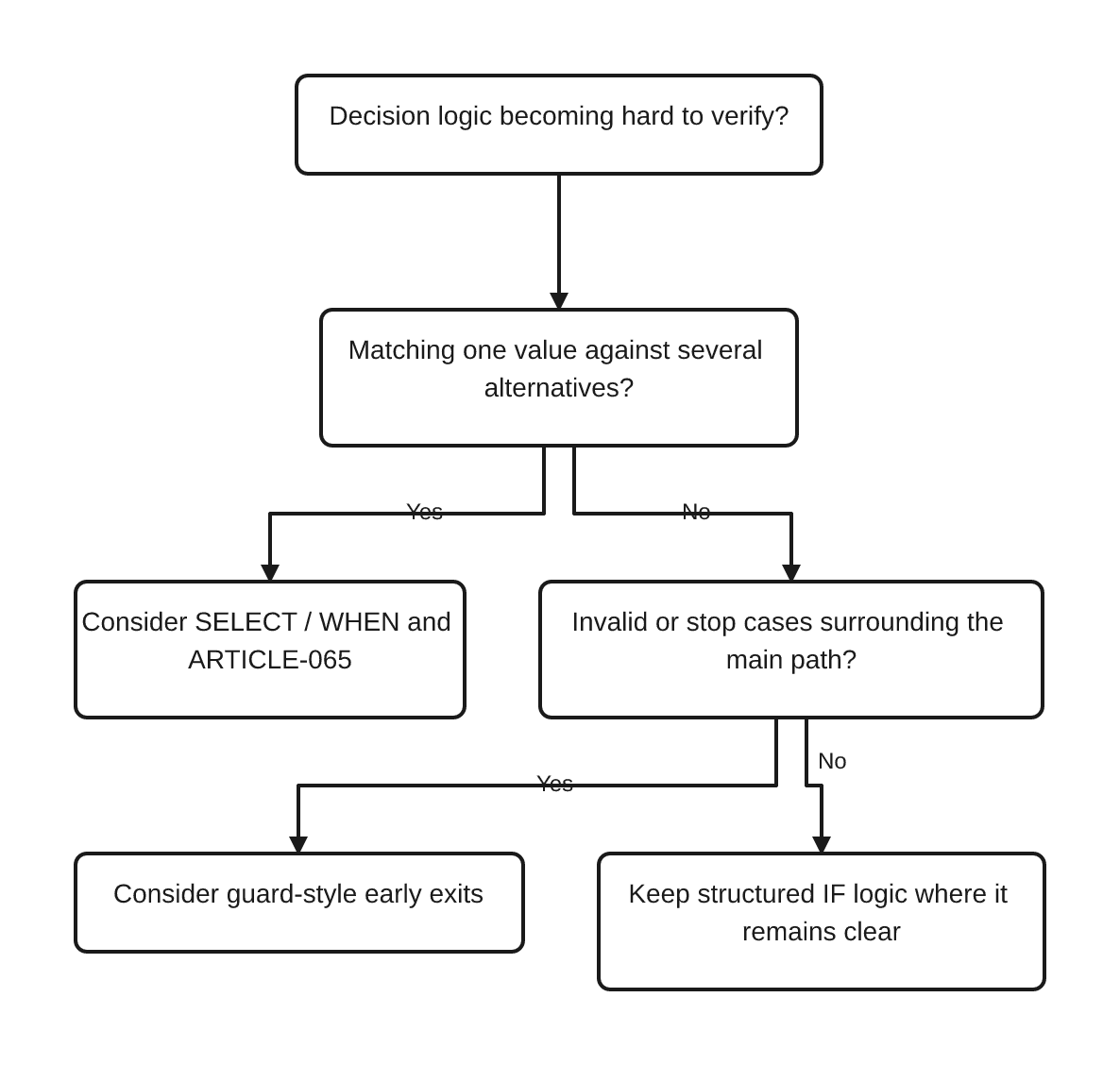
SELECT/WHENfor a readable list of alternatives; use guard-style exits when stop cases surround one main path; retain ordinaryIFlogic when it is already clear. - There is no editorial magic number of nesting levels at which code must be rewritten.
Reader Prerequisites
This tutorial assumes you can already read the conditions and controlled blocks taught in RPGLE IF, ELSE, and ELSEIF Decisions. That article owns the fundamental syntax, including ENDIF; this one focuses on arranging complete decisions.
You should also recognize an ordered multi-branch choice from RPGLE Select and When Logic. SELECT/WHEN is relevant when repeated alternatives are the source of the problem, but it is not a substitute for every nested validation flow. The broader sequence is collected in RPGLE for Beginners: A Practical IBM i Learning Path.
Learning Outcomes
By the end, you should be able to:
- Find the main path inside a nested RPGLE decision.
- Separate stop-processing cases from the successful business action.
- Refactor suitable checks into early
RETURNstatements inside a procedure. - Compare the nested and flattened versions for equivalent outcomes.
- Explain why guard clauses are guidance rather than new RPG syntax.
- Keep a small nested decision when dependency makes that shape clearer.
- Choose a decision structure based on the rule’s shape instead of a nesting-count rule.
Why Decision Logic Becomes Hard to Read
Decision code becomes difficult when its visible shape no longer matches the question a maintainer is trying to answer. Consider a procedure whose purpose is to process a valid order. A reviewer usually wants to know two things:
- What prevents processing?
- Where does normal processing occur?
With progressive nesting, the answer to the second question may be inside every successful branch. The reviewer must hold “customer active,” “quantity positive,” “amount positive,” and “stock sufficient” in working memory while following indentation inward. After finding the action, the reviewer must trace outward again to determine which result belongs to each failed check.
The compiler does not measure this mental cost. It is a maintenance concern. Short blocks, clear names, and genuine parent-child decisions can make nested code easy to understand. Conversely, even a modest amount of nesting can be awkward if its only purpose is to protect one final action from a series of independent invalid cases.
A Small Nested Decision
Here is the core of a procedure that validates an order and returns a result string:
dcl-s result varchar(24) inz('inactive-customer');

if customerStatus = 'A';
  result = 'invalid-quantity';
  if requestedQty > 0;
    result = 'invalid-amount';
    if orderAmount > 0;
      result = 'insufficient-stock';
      if availableQty >= requestedQty;
        result = 'order-processed';
      endif;
    endif;
  endif;
endif;

return result;
Every individual IF is straightforward. IBM defines an IF condition as an indicator expression and performs the controlled operations when that expression is true.2 IBM also describes complete structured groups inside other structured groups as nested groups.5 Nothing about this example is invalid merely because it nests.
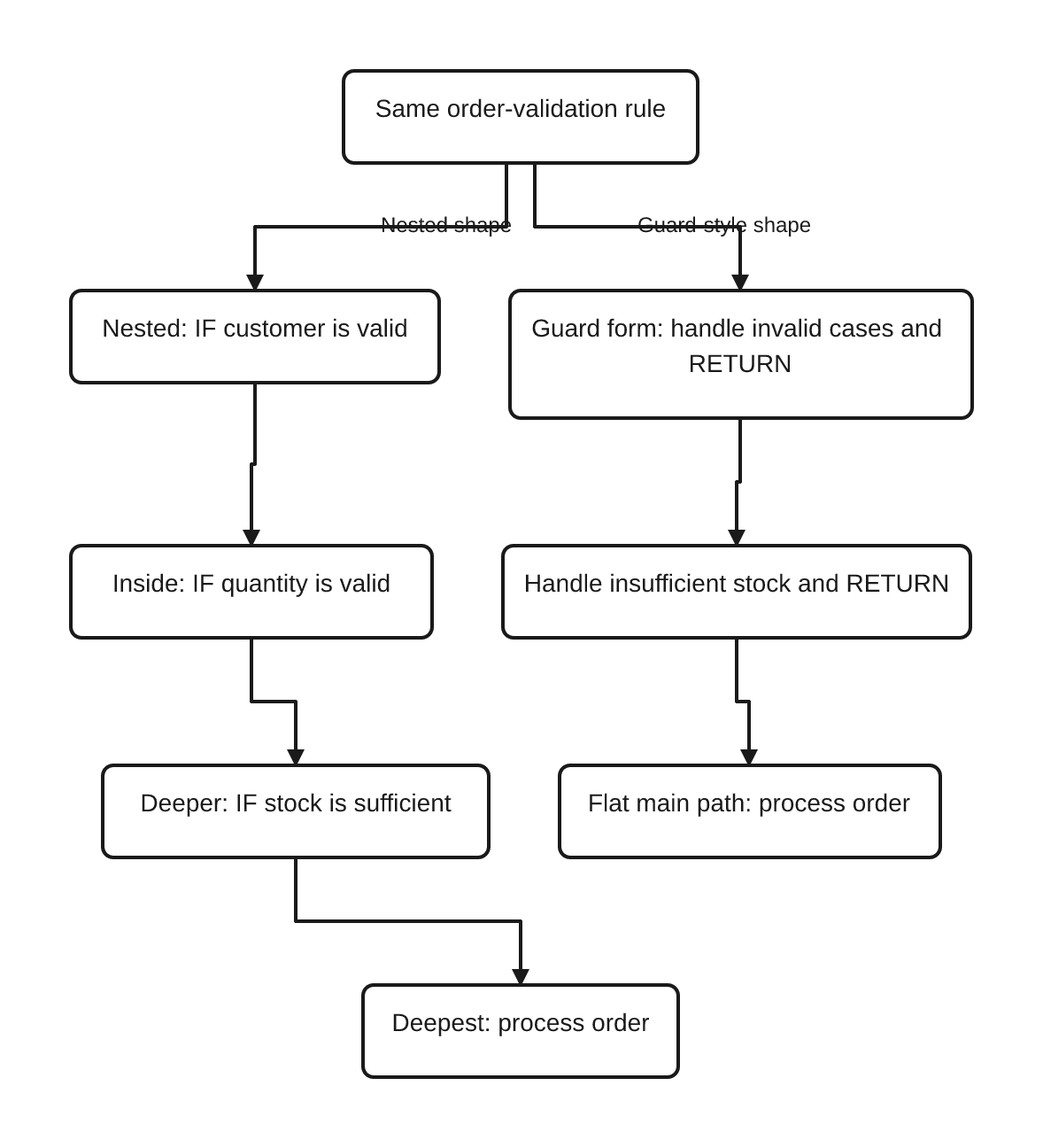
The issue is the reading path. order-processed appears only after four successful checks. Failure results are assigned before the next level, so understanding why a particular result survives requires tracking both the condition and the most recent assignment.
The complete version is nested-decision-example.rpgle. It initializes an active customer, positive values, and enough stock, so its expected display is order-processed.
How Deep Nesting Hides the Main Path
A useful review technique is to mark the code’s main action, then count the conditions a reader must reconstruct to reach it. Do not turn that count into a universal threshold. Instead, ask whether the indentation communicates real dependency.
In the order example, each validation asks whether processing may continue. The negative answers are terminal results. They do not open substantial alternative workflows, and later checks do not need to live visually inside earlier blocks to make sense. The nesting therefore emphasizes successful validation mechanics more than the business action.
There are other warning signs:
- The successful action is a small statement at the deepest indentation level.
- Most
ELSEpaths only reject, report, or stop. - A reader repeatedly scans matching
ENDIFstatements to locate the continuation point. - Adding one validation requires indenting the entire remaining path.
- A code review spends more time reconstructing control flow than checking the business rule.
These are prompts to examine the structure, not proof that a refactor is required.
The Guard-Clause Mental Model
A guard clause answers one narrow question near the top of a procedure: “Is there a reason this procedure should not continue?” If so, it produces the required result and leaves. If not, execution continues to the next check.
For the order flow, read the guards as a sequence:
- An inactive customer cannot continue.
- A nonpositive quantity cannot continue.
- A nonpositive order amount cannot continue.
- Insufficient stock cannot continue.
- After those cases are excluded, process the order.
The first four steps protect the fifth. Their shape makes the successful case a consequence of passing the guards rather than the innermost member of four blocks.
This pattern does not add an RPGLE GUARD keyword. The examples use ordinary IF, ENDIF, and RETURN. IBM defines RETURN as returning control to the caller and documents how its expression supplies the result of a value-returning subprocedure.1 The label “guard clause” describes why the code is arranged that way.
Refactor Nested Logic with Early Exits
The flattened version makes each failure explicit:
if customerStatus <> 'A';
  return 'inactive-customer';
endif;

if requestedQty <= 0;
  return 'invalid-quantity';
endif;

if orderAmount <= 0;
  return 'invalid-amount';
endif;

if availableQty < requestedQty;
  return 'insufficient-stock';
endif;

return 'order-processed';
Each block now states a complete stop case. After its ENDIF, the reader knows that case is not true. The final line is the visible main path.
The full member is guard-clause-refactor.rpgle. It uses the same procedure name, parameters, initialized inputs, validation order, and result strings as the nested member. Only the control-flow shape changes.
The word “early” is relative to the procedure: a failed check returns before reaching the normal return at the end. It does not mean that RPG partially evaluates a compound expression, and this tutorial makes no short-circuit claim. Every condition is a separate, side-effect-free comparison.
Worked Example: Flatten a Validation Flow
Refactoring safely requires more than reversing comparison operators. Work from an outcome table.
| First condition that prevents processing | Nested result | Guard-style result |
|---|---|---|
customerStatus <> 'A' | inactive-customer | inactive-customer |
requestedQty <= 0 | invalid-quantity | invalid-quantity |
orderAmount <= 0 | invalid-amount | invalid-amount |
availableQty < requestedQty | insufficient-stock | insufficient-stock |
| No stop condition | order-processed | order-processed |
The phrase “first condition” matters. Suppose both quantity and amount are invalid. The original code stops progressing after the quantity check, so its observable result is invalid-quantity. The guard-style version checks quantity before amount and returns the same result. Reordering the guards could change behavior even if every individual condition remains present.
Use this refactoring sequence:
- Identify the normal action and every terminal outcome.
- Record the existing priority when multiple invalid facts can coexist.
- Convert one terminal case at a time into its opposite test and early return.
- Keep side effects in the same relative order.
- Leave the successful action after the guards.
- Test each outcome independently on the target system when that environment is available.
In this workspace, the code is documentation-reviewed rather than compiled or executed on IBM i. The table is an intended-behavior check, not captured runtime evidence.
When Nesting Is Still the Clearer Choice
Nesting remains natural when the inner question depends on the outer answer. For example, expedited handling matters only for an order that is pending:
if orderStatus = 'P';
  if expedited = *on;
    return 'expedite-release';
  else;
    return 'standard-release';
  endif;
endif;

return 'not-pending';
The inner decision reads as a detail of the pending-order case. It is short, its alternatives are adjacent, and the main relationship is immediately visible. Flattening it into two separate top-level checks could repeat orderStatus = 'P' or require a compound expression that adds no clarity.
The complete example is when-nesting-is-acceptable.rpgle. This is deliberately a small counterexample to “nesting is always bad.” The choice depends on whether the visual containment helps a reader understand dependency—not on a magic nesting-depth number.
IF vs SELECT/WHEN vs Guard Clauses
These choices solve different readability problems:
| Structure | Use it when | What it makes visible | Watch for |
|---|---|---|---|
Ordinary IF or modest nesting | One condition protects an action, or an inner choice genuinely depends on an outer case | The dependency between conditions | An important main path drifting inward without benefit |
IF/ELSEIF | A small set of ordered conditions expresses business priority | The first eligible branch | A broad condition placed before a specific one |
SELECT/WHEN | Several alternatives read as one ordered selection, often around the same subject | The list of alternative routes | Using selection syntax to disguise deeply complex branch bodies |
| Guard-style early exits | Invalid, exceptional, or stop cases surround one normal path inside a procedure | Each stop reason and the flat main path | Scattering exits so widely that cleanup or outcomes become hard to audit |
IBM documents ELSEIF as avoiding an additional nesting level, which supports using an ordered chain when another nested IF would merely express the next alternative.3 IBM documents SELECT as considering WHEN conditions in order and selecting the first satisfied one.4 Neither source tells you to use a guard clause; that remains a maintainability judgment.
Readability Guidance
- Name every condition and result after the business fact it represents.
- Put one stop reason in each guard so its outcome is easy to scan.
- Preserve priority when more than one invalid condition can be true.
- Keep guard conditions free of side effects and hidden mutations.
- Keep related cleanup visible before an early exit; do not bypass required work.
- Prefer a value-returning procedure result that the caller can handle deliberately over an unexplained display or global flag.
- Do not force a guard structure when a compact nested true/false relationship reads naturally.
- If several branches are alternatives rather than stop cases, reconsider
SELECT/WHEN. - Comment the business reason for unusual ordering, not the syntax already visible in the code.
A helpful final review is to read only the left edge of the procedure. In the guard-style example, the reader sees four peer IF blocks followed by one normal return. In the nested example, the left edge shows only the outer check and the final return; the remaining rule must be recovered from indentation.
Common Mistakes
Calling a guard clause an RPG operation. RPG provides IF and RETURN; “guard clause” names an arrangement of those operations.
Changing validation priority during refactoring. If several inputs are invalid, moving a guard can change the result returned first.
Inverting a condition incorrectly. The stop case must be the logical complement of the former continue case. Check boundary values such as zero rather than relying on visual similarity.
Returning from the wrong scope. RETURN returns to the caller; it does not merely skip to the statement after the current IF.1 Use it only when ending the current procedure is the intended result.
Bypassing required cleanup or state changes. Before adding an early exit, identify work that must occur for every outcome and place or structure it appropriately.
Replacing every nested decision. A concise inner decision can express dependency better than repeated or compound top-level conditions.
Using one compound expression to imitate several guards. That can hide which condition caused rejection and tempt assumptions about operand evaluation. Separate checks avoid any short-circuit dependency here.
Applying a magic depth limit. A nesting count cannot decide readability without considering block size, dependency, naming, and business context.
FAQ
What is a guard clause in RPGLE?
It is a readability pattern in which a procedure handles an invalid, exceptional, or stop-processing condition near the beginning and exits before the main path. It is not a special RPGLE operation. This tutorial implements the pattern with IBM-documented IF and RETURN statements.21
Can an RPGLE procedure return early?
Yes. IBM states that RETURN causes a return to the caller. For a subprocedure with a declared result, the expression on RETURN supplies the value passed back to the caller.1
Are multiple RETURN statements bad practice?
Not inherently. Several focused returns can make terminal cases clear, while poorly placed returns can make outcomes or cleanup difficult to audit. Judge the complete procedure, not the count alone.
Are nested IF statements bad in RPGLE?
No. IBM recognizes nested structured groups, and a small nested choice can clearly communicate that one question depends on another.5 The maintenance problem arises when nesting hides rather than explains the rule.
How do I preserve behavior when flattening nested conditions?
List every outcome, retain the order in which competing conditions are resolved, invert each continue condition carefully, and keep side effects in the same relative order. Then test each outcome on IBM i when a compiler and runtime are available.
When should I use SELECT/WHEN instead?
Consider SELECT/WHEN when the code is choosing one route from several ordered alternatives, especially when one value is repeatedly matched. IBM documents the first-satisfied WHEN behavior; the linked ARTICLE-065 tutorial covers the structure in depth.4
Do guard clauses depend on short-circuit evaluation?
No such dependency is needed here. Every guard is a separate IF with a side-effect-free comparison. This article does not claim an operand-evaluation order.
Key Takeaways
- RPGLE guard clauses are a readability pattern, not language syntax.
- Progressive nesting can hide a main action even when every individual
IFis valid. - Separate early exits can make invalid and stop-processing cases explicit.
- IBM-documented
RETURNends the current procedure invocation and can supply a subprocedure result. - A safe refactor preserves validation priority, outputs, and side effects.
- Nesting remains useful when it communicates a genuine parent-child decision.
- Choose ordinary
IF,SELECT/WHEN, or guard-style flow according to the business shape, not an arbitrary threshold.
Continue Your Learning
- Pillar: RPGLE for Beginners: A Practical IBM i Learning Path (ARTICLE-046)
- Foundation: RPGLE IF, ELSE, and ELSEIF Decisions (ARTICLE-064)
- Related prerequisite: RPGLE Select and When Logic (ARTICLE-065)
- Current: RPGLE Nested Decisions and Guard Clauses (ARTICLE-066)
- Recommended next: RPGLE Boolean Logic and Comparison Patterns (ARTICLE-067)
- Then: RPGLE DO Loops Explained (ARTICLE-068)
ARTICLE-067 and ARTICLE-068 are named from the canonical cluster registry but are intentionally not linked because this repository does not yet provide publishable article destinations for them.
IBM Evidence Used
The IBM i 7.5 ILE RPG Reference supports the language behavior used here: IF controls a group based on an indicator expression, complete structured groups may be nested, and RETURN returns control to the caller and supplies a declared subprocedure result when applicable.251 The ELSEIF and SELECT references support only the concise structure-choice comparison.34
The IBM i 7.4 IF and RETURN topics were cross-checked for the same constructs.76 No publication dates are assigned to IBM Docs pages. IBM’s documentation establishes language behavior; the recommendations about guards, flat main paths, and review effort are editorial guidance from this tutorial.
References
IBM, RETURN (Return to Caller), IBM i 7.5, accessed 2026-09-12. ↩↩↩↩↩↩↩
IBM, IF (If), IBM i 7.5, accessed 2026-09-12. ↩↩↩
IBM, ELSEIF (Else If), IBM i 7.5, accessed 2026-09-12. ↩↩
IBM, SELECT (Begin a Select Group), IBM i 7.5, accessed 2026-09-12. ↩↩↩
IBM, Structured Programming Operations, IBM i 7.5, accessed 2026-09-12. ↩↩↩
IBM, RETURN (Return to Caller), IBM i 7.4, accessed 2026-09-12. ↩
IBM, IF (If), IBM i 7.4, accessed 2026-09-12. ↩
References
- RETURN (Return to Caller) — IBM
- IF (If) — IBM
- Structured Programming Operations — IBM
- ELSEIF (Else If) — IBM
- SELECT (Begin a Select Group) — IBM
- IF (If) — IBM
- RETURN (Return to Caller) — IBM